Rabbit Hendricks
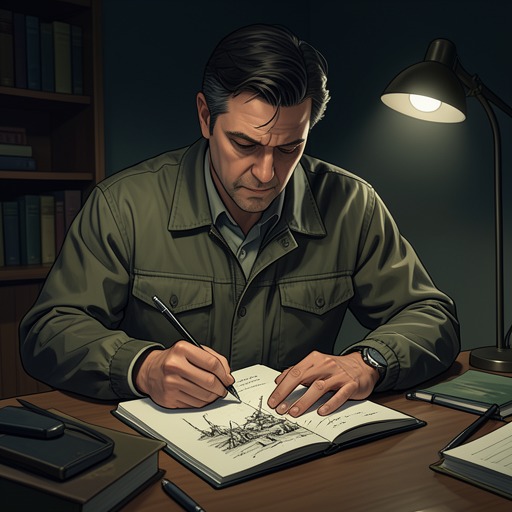
The Narrow Road to the Deep NorthRabbit Hendricks is a prisoner of war and artist whose sketches preserve people, relationships, and events under conditions designed to erase individual lives. He draws for fellow prisoners and, at times, for the Japanese commander; the same skill that earns him small provisions also puts him at risk when he records camp life as it is actually lived. After cholera takes him, his sketchbook survives a cremation pyre and becomes the remaining record of one of the men it depicts.
Identity and Introduction
Rabbit is introduced among a group of Australian servicemen in Syria, where the war reaches a village in the middle of a morning gathering. Compact and wearing ill-fitting dentures, he is finishing a portrait on the back of a postcard of Damascus. The drawing is a replacement for a photograph of Maisie, the wife of Lizard Brancussi, whose image has deteriorated until her face can scarcely be made out. Rabbit preserves the pose while changing the portrait’s effect: his version is more direct and alluring than the damaged photograph.
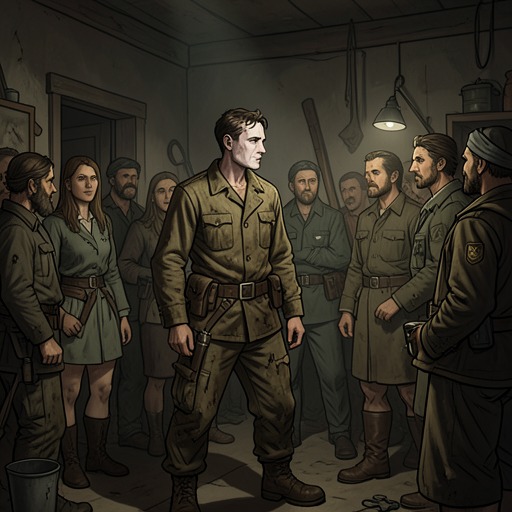
The drawing does not simply reassure Lizard. He senses that it may be false and feels troubled by the difference, even as the other men admire it. He offers Rabbit his watch in exchange, explaining how much the portrait means to him; Rabbit refuses the payment. Instead, he takes out a sketchbook and draws the men gathered around their morning coffee. The sequence establishes a recurring feature of his art: it is made among other people, attentive to what they value, and capable of preserving a shared moment as well as an individual likeness.
An Artist Among the Prisoners
Rabbit’s sketching continues in captivity, where his artistic ability becomes useful to men on both sides of the prison-camp divide. The camp’s Japanese commander gives him two duck eggs in return for postcard pictures of the commander and some of his associates, apparently for their loved ones in Japan. These commissioned portraits bring Rabbit provisions in a setting where food is scarce. They also reveal the uneasy terms on which his skill is used: the Japanese sometimes ask him to draw, but the pictures that document their treatment of prisoners would endanger him if discovered.
Rabbit therefore hides watercolours and drawings of daily camp life, including forced labour, beatings, and torture. His art has two audiences and two purposes. The postcard pictures answer requests from the authorities; the concealed work records what the authorities would not want represented. The danger surrounding those hidden images is not abstract. Rabbit must keep them secret while continuing to work under the same command that supplies the materials of his survival.
His resourcefulness is also bound up with the prisoners’ informal exchange of scarce goods. Rabbit trades a duck egg for a paintbrush that Darky Gardiner has taken from a Japanese officer’s field satchel. The brush links his work to the small acts of acquisition and barter by which men obtain necessities. It is one more example of his art being sustained not by a secure studio or supply of materials, but by arrangements made within captivity.
Captivity, Illness, and Death
After the prisoners are sent from Changi in closed railway wagons, the journey to the railway works lasts five days. Twenty-seven men are packed into each rice wagon without enough room to sit comfortably; the journey ends with the surviving prisoners transferred to trucks at Ban Pong. Rabbit’s individual actions are not singled out during the journey, but he is part of the group carried into the forced labour that will define life on the railway.
As the monsoon arrives, food dwindles and the Speedo removes rest days, raises work quotas, and lengthens shifts. The prisoners work with hand tools to clear jungle, break rock, and move earth for the railway. In this setting, Rabbit continues to draw, even as the labour and illness around him place both his life and his record in danger.
Cholera begins spreading through the camp. While finishing a shift on the Line, Rabbit becomes acutely ill and has to be carried back to camp. Chum Fahey and two other prisoners help Darky carry him along the Dolly, the jungle track connecting the railway to the camp, while searching in the dark for Rabbit’s lost dentures. They reach camp shortly before midnight. Rabbit, his watercolour set, his sketchbook, and his concealed drawings are then sent into the cholera compound, from which few prisoners return. His illness stops his work, and the sketches he kept hidden disappear from the story with him.
The Sketchbook After Rabbit
At the funeral pyre, Jimmy Bigelow recognizes Rabbit among the cholera dead. Because the disease demands that a dead prisoner’s possessions be burned, the pyre makers bring Rabbit’s sketchbook to Dorrigo Evans and ask what to do with it. Bonox Baker explains that it is a record meant to let people in the future know what happened to the prisoners. Dorrigo initially tells them to burn it, but the request makes the book’s significance explicit: it is not merely Rabbit’s property, but a possible witness to their experience.
The pyre is set alight, and Dorrigo helps the pyre makers keep the remains within the fire. When the men are preparing to leave, he notices Rabbit’s sketchbook lying in the mud. It is slightly charred, its card cover and early pages gone, but the remaining pages are intact. Dorrigo picks it up, intending to throw it back into the fire, then changes his mind.
The surviving front page returns the narrative to the morning in Syria. It shows Darky seated in the opulent armchair, drinking coffee in the ruined village, with the others behind him. Yabby Burrows is among them, carrying the hot boxes that had arrived just before the shelling killed him. Rabbit must have added Yabby to the picture after his death. The page thus preserves not only the earlier gathering but also a detail Rabbit could have included only after the event: the image has become a record revised by loss.
Narrative Significance
Rabbit’s story connects drawing with the struggle against forgetting. His portrait of Maisie gives Lizard a new image where a photograph is failing; his coffee-time group portrait catches the men together before the attack; his hidden pictures document what the official commissions leave out. These works differ in purpose, but all insist that particular people and moments are worth recording.
The sketchbook’s survival is partial and precarious. It loses its cover and early pages, and Rabbit himself does not survive to explain or complete it. Yet its remaining image holds together the morning gathering, Yabby’s death, and Dorrigo’s later decision not to destroy the record. Rabbit’s art cannot undo what happened or restore the dead. It can, however, resist the disappearance of names and faces by leaving evidence that someone saw, drew, and remembered them.